


/https%3A%2F%2Fprofilepics.canalblog.com%2Fprofilepics%2F1%2F6%2F165160.jpg)
Une miche au levain "façon" Poilâne / Poilâne - style sourdough miche
J’ose dire que presque tout le monde a entendu parler du fameux pain Poilâne, une miche au levain d’environ 1,9kg, avec une croûte épaisse et farinée signé P pour Poilâne. Je ne vous raconterai pas toute l’histoire de ce boulanger qui avait fait le choix de travailler à l’envers des tendances de son temps. Vous trouverez ça ICI.
Quand j’étais à Paris récemment, j’avais quelques heures à brûler avant de prendre mon train, et j’ai décidé d’aller à pied jusqu’à la boulangerie Poilâne, rue Cherche-midi, sous la pluie. Quelle excitation quand j’ai enfin trouvé cette toute petite boutique, avec des miches et des pains décorés dans la vitrine. La boutique était chaleureuse et accueillante avec trois dames souriantes prêtes à répondre à toutes mes questions.
Comme j’ai vu dans leur dépliant que les visites étaient proposées, j’ai osé demander si c’était possible de descendre voir le four et les boulangers au travail et elle m’ont pointé la direction.
I think that most people have heard of the famous French bread of Poilâne, a sourdough miche weighing around 1,9 kg, with a thick crust signed with the letter « P » for Poilâne. I won’t tell you the story of this talented baker that went against the tide of his time, you can read about it here.
While I was in Paris recently, I had a few hours to waste before catching my train and I decided to go find the Poilâne Bakery, rue Cherche-midi, by foot under the rain. How excited I was to finally arrive at the tiny bakery with the famous miches and decorated breads in the window. The shop was warm and inviting with three smiling women ready to answer all my questions.
Having read on their brochure that visits were possible, I dared to ask if I might go down and see the oven and the bakers at work. They simply pointed the way !
J’ai descendu un escalier en courbe, tout en pierres, polies et arrondies par le temps. La pièce en bas était en longueur, pas grande du tout avec le four à bois comme un autel central et qui dégageait une chaleur constante et assez puissante. J’avais l’impression de pénétrer dans un autre siècle. Il y avait un seul jeune boulanger au travail qui s’occupait de la cuisson des pains et les décors en pâte morte. Je lui ai demandé à un moment s’il savait qu’il pleuvait dehors et il m’a répondu que non, il ne le savait même pas. Les autres boulangers travaillaient dans une pièce derrière (certainement pour le pétrissage, façonnage, confections des viennoiseries, sablés, etc).
I went down a very old flight of steps made of stones so worn and polished by time. The room downstairs was small and long, with the great wood oven built into the wall, standing like an altar, radiating an intense warmth into the room. I felt like I had just entered in to another century. There was a young baker busy baking bread and working on some pâte morte. I asked him if he knew it was raining outside and he said, no, he wasn’t even aware of that. The other bakers were working in another room behind (probably busy with the dough preparation, shaping, making viennoiseries and sablés).
Il m’a expliqué certaines choses sur le fonctionnement de la boulangerie et la fabrication du pain. Je n’avais pas le droit de prendre des photos, je suppose pour garder les secrets de cet endroit loin de la vie dehors où se fabrique le fameux pain. Mais il a bien voulu répondre à toutes mes questions sur la miche. Il y avait le bac de levain et j’ai pioché ma main dedans pour le toucher et le goûter. Il avait un goût légèrement acidulé et complex. C’est difficile à expliquer. Quand on a l’habitude de goûter le levain, avec le temps, on arrive à distinguer ses qualités comme le vin par exemple. Leur levain est une pâte fermentée, c’est-à-dire, une portion de la pâte de la production de la journée qui est gardée et puis utilisée comme chef.
The baker explained things to me about the functioning of the bakery and the making of the bread. I wasn’t allowed to take pictures (I didn’t have my camera anyway), I suppose to keep certain secrets about this hidden place where the famous bread is made. But he was very helpful in answering my questions about the miche. The kneading machine with the levain sitting inside was right there and I dipped my hand in to take a small piece, to feel it and taste it. The taste was lightly acidic, with a very complex flavor. It’s difficult to explain. When you’ve tasted a lot of sourdough, with time, you descern flavors like some taste wine. The levain that is used is really a pâte fermentée, taken from the days dough production.
Il a expliqué qu’ils utilisent que de la farine T80 ! Ah hah ! Bon, ça se voit par la couleur de la mie, mais en même temps peut-être ils ajoutent aussi une touche d’une autre farine, ou du germe de blé. Mais non, il m’a dit que de la farine T80 et comme la pâte fermentée vient de cette même pâte, il a dit que le levain est pareil.
He explained that they only use T80 flour, which is much like the American high extraction flour, though maybe slightly whiter. I spoke about this flour HERE. The color of the miche is slightly grey, which is a classic T80 characteristic. The pâte fermentée is of the same flour (obviously, since it is taken from the bread !) I thought maybe there were some addition, maybe rye, or wheat germ, but no, he said it was just straight T80.
Malheureusement, j’ai appris qu’en France les boulangers utilisent les proportions selon le kilo d’EAU ! Alors quand il me donnait ses proportions, ça me disait rien et lui, il n’a pas pu traduire. Je n’ai pas pu demander de prendre des notes, ça ne se fait pas.
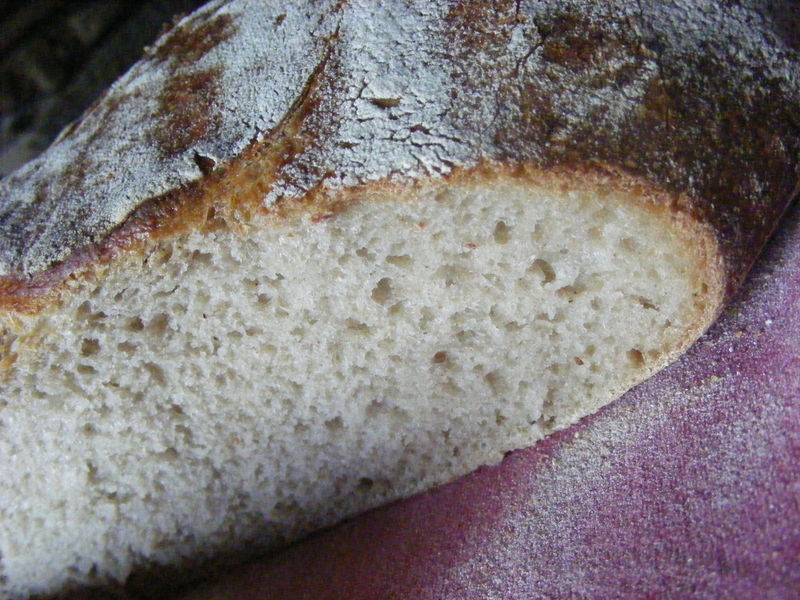
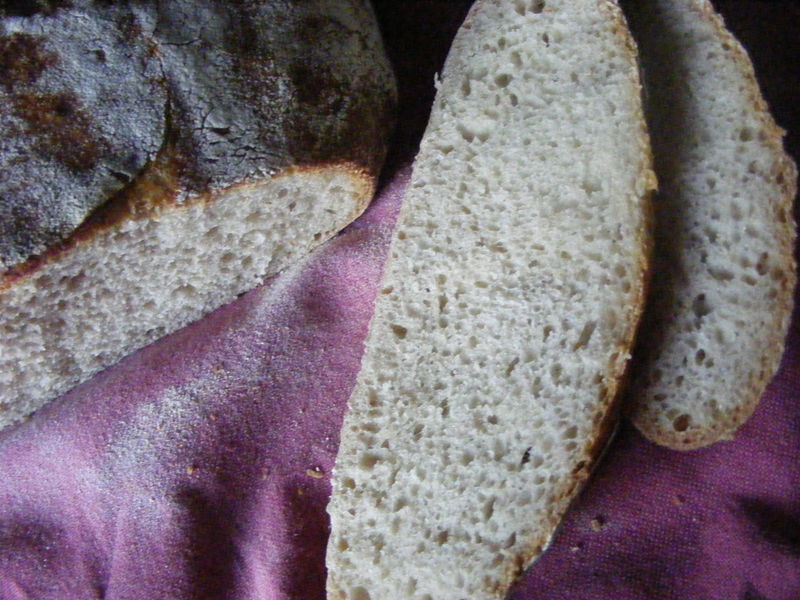
Mais bon, j’avais appris quelle farine est utilisée et que c’est fait sur une pâte fermentée. Comme j’en ai acheté une de ces miches, j’ai pu étudier les caractéristiques et le goût. J’ai pris plein de photos de ma miche, mais je les ai perdues ! La croûte est épaisse et à la maison il est impossible de faire une cuisson semblable à celle dans un four à bois (sauf si vous en avez un !). Dans un four traditionnel électrique ou à gaz, la croûte va être plutôt fine et croustillante. La mie du pain est plutôt serrée et moelleuse. Le taux d’hydratation n’est donc pas très élevé.
Unfortunately, I learned that in France, bakers use proportions based on 1kg of water. So, when he started talking about proportions, I couldn’t understand and he couldn’t give me regular bakers percentages. I couldn’t ask to take notes, that would have been « unacceptable ».
But, I had learned that the flour used is T80 and that the bread is made with a pâte fermentée. I bought a miche and so I could look at it’s characteristics and its taste. I took some photos of my miche, but I lost them during a transfer. The crust is thick and floury, so at home, the same type of baking just isn’t possible, unless one has a wood oven. With a regular oven, the crust will be thiner and crunchier. The crumb is quite tight without being heavy. The hydration level isn’t very high.
La question qui me perturbait un peu, surtout que le boulanger me l’avait dit mais que je ne me souvenait pas à cause des différence de calculs, c’est COMBIEN de pâte fermentée.
Je me suis dit qu’une proportion d’un tiers pourrait être très bien pour plusieurs raisons :
A la boulangerie ils ne se servent pas de la fermentation lente au frais (5°C) alors il faut quand même une quantité assez importante pour que la pâte lève assez rapidement.
Puisque le levain est peut-être mis dans un endroit plus frais, il n’est pas mis au froid, alors si la pâte a trop de levain, elle s’épuisera trop rapidement. Un tiers de levain dans la pâte permettra une fermentation pas trop rapide à une température moins de 19°C. Le lendemain, le nouveau sera prêt à être utilisé. Trop peu et le cycle sera trop lent.
Mais je ne sais pas s’ils utilisent une série de « builds », c’est-à-dire que ce levain chef est nourri une ou deux fois avant d’être utilisé dans une nouvelle pâte.
Pour le taux d’hydratation, j’ai choisi 63% car comme j’ai déjà dit, la mie est plutôt serrée, sans être trop compacte. La forme de la miche n’est pas en boule, mais pas très très aplatie non plus. Pour le sel, j’ai choisi d’utiliser 1,9%.
The question that was bothering me, especially since the baker told me the answer but I didn’t really get it because of the calculation differences, was HOW MUCH levain to use.
I thought that a third would be a good place to start for several reasons :
At the bakery, they don’t use cold retarding (5°) and so if there is too much levain to dough, it’ll ferment too quickly. At a third, the pâte fermentée would be ready to use if kept in an area under 19°C. If there was less, it wouldn’t necessarily be ready in time.
Now, I don’t know if they do a series of builds or if the dough is simply placed in a cooler place and then used the next day.
For the hydration level, I chose 63% because the crumb is fairly tight without being compact. The miche isn’t a ball shape, it is slightly flattened without being very flat.
For the salt, I chose 1,9%
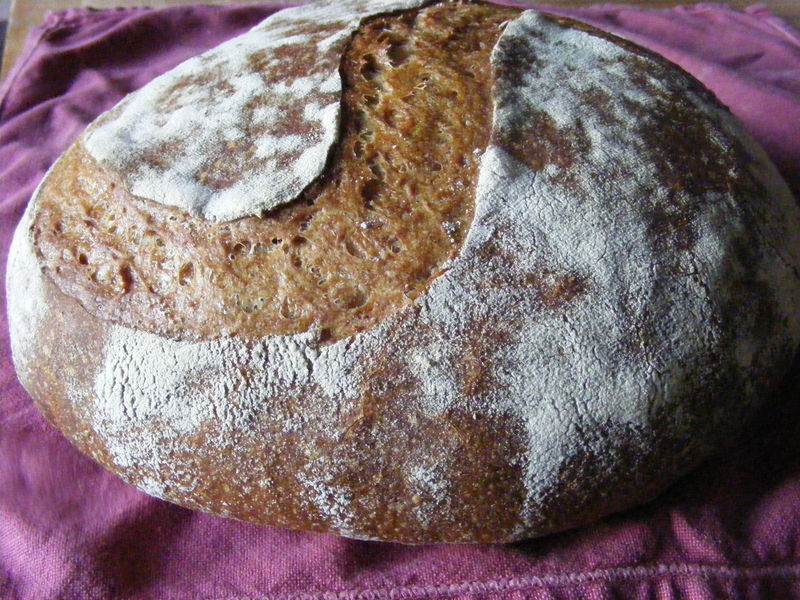
Avant de donner ma recette, je dis haut et clair que c’est impossible de refaire exactement le MÊME pain que la miche Poilâne à la maison. Le pain au levain est comme les personnes. On peut trouver deux personnes avec des cheveux châtaignes et des yeux bleus, mais il n’y aura jamais deux pareilles. Cela dit, je trouve que le résultat est aussi bon est avec sa forme et son goût, la texture de la mie et la croûte qui se ramollit après une journée, on retrouve les mêmes avantages et caractéristiques avec cette miche. Toutes les recettes qu’on trouve dans le site internet de Poilâne et ailleurs peuvent être réalisées avec cette miche et elle a aussi la même durée de conservation.
Je l’ai faite plus petite car un pain d’un kilo me suffit mais vous pouvez augmenter les proportions en utilisant les pourcentages du boulanger (ICI) et la cuisson en conséquence.
J’ai marqué la mienne avec « J » pour Jane !
I would really like to say, before writing up the recipe, that it is absolutely impossible to do the exact Miche Poilâne at home. Sourdough bread is like people. You can have two people with brown hair and blue eyes, but they won’t be the same.
This said, I am very pleased with the results, with it’s shape and it’s taste, the texture of the crumb and the crust when it softens up a bit. The same characteristics and advantages of the original miche can be found in this homemade bread. The recipes that can be found on the Poilâne site or on the internet can be made using this bread and the keeping length is the same.
I made my miche smaller than the Poilâne because 1 kg of bread is enough for us. You can make it bigger by increasing the proportions using the bakers percentages (here) and the baking time.
I marked mine with a J for « Jane ».

La veille - Pour la pâte fermentée :
The day before - Pâte fermentée :
Il y a deux façons pour procéder. There are two possibilities.
- Préparez une recette, comme mon pain T80 (ICI), laissez lever la pâte pendant 3 - 4 heures, puis mettez-la au frais toute la nuit. Le lendemain, la pâte aura doublé. Prélevez la portion nécessaire pour faire la miche. Avec celle qui reste, vous pouvez la façonner, laisser lever encore 2-3 heures et la faire cuire. (C’est ce que j’ai fait)Prepare a recipe, like my T80 bread (here), leaving the dough to rise a few hours and then placing in the fridge over night. The newt day i twill have doubled and be ready to use. Take the portion necessary for the leaven. With the rest, you can form it, leave it to rise and then bake it .(That’s what I did
- Préparez une portion de pâte à pain exprès/Prepare a portion of bread dough in the correct proportions :
95 g farine T80 bio meulée sur pierre (T80 – or stone ground high extraction flour)
60 g eau (water)
35 g levain 100% (starter at 100%)
1,7 g sel gris de Guérande moulu (ground grey Guérande salt)
Dans un bol mélangez tous les ingrédients. Pétrissez pour faire une jolie boule bien lisse. Placez-la dans un bol bien couvert et laissez fermenter 3 heures, puis mettez au frais toute la nuit.
In a bowl, mix all the ingredients and knead until a nice, smooth ball is formed and then place in a bowl, covered. Leave it to ferment about 3 hrs, then place in the fridge over night.
(Vous pouvez gardez les 10g restant et les nourrir pour garder ce levain ferme)
(You can keep the 10 g that are left and feed it to keep the firm starter)
Le jour de cuisson – La pâte :
Baking day – The dough
600 g farine T80 bio meulée sur pierre (T80 – or stone ground high extraction flour)
180 g pâte fermentée
378 g eau à température ambiante (room temperature water)
10,8 g sel gris de Guérande moulu (ground grey Guérande salt)
Autolyse : Dans un bol, mélangez l’eau et la farine. Remuez avec une cuillère à bois jusqu’à ce que la farine soit entièrement mouillée. Couvrez et laissez reposer 30 min.
Autolyse : In a bowl, mix the flour and water until the flour is fully hydrated. Cover and let rest 30 min.
Pétrissage : Ajoutez le sel et la pâte fermentée coupée en morceaux. Pétrissez soit avec un mixeur avec un crochet, soit avec les mains pendant 5-10 minutes jusqu’à ce que la pâte forme une jolie boule bien lisse.
Transférez la pâte dans un bol, couvrez avec un film plastique ou un torchon humide.
Kneading : Add the salt and the pâte fermentée cut in to pieces. Knead the dough either in a mixer or by hand 5-10 minutes until a nice, smooth ball is formed with adequate gluten development.
Place the dough in a bowl and cover with platic wrap or a damp cloth.
1ère fermentation : Laissez lever la pâte 3-4 heures jusqu’à ce qu’elle soit bien levée en sachant qu’elle ne doublera pas.
1st fermentation : Let the dough rise 3-4 hrs until it has visibly risen, but it won’t double.
Façonnage : Farinez un banneton rond. Posez la pâte sur un plan légèrement fariné. Formez une boule en vérifiant que sa peau soit bien tendue. Posez la boule, clé vers le haut, dans le banneton. Couvrez avec un film ou un torchon humide.
Shaping : Flour a round banneton. Place the dough on a lightly floured table. Form a ball, making sure the « skin » is nice and taught. Place it in the banneton with the seam on top. Cover with plastic or a damp cloth.
2ème fermentation : Laissez lever la pâte 2-4 heures selon la température ambiante. Il faut laisser la pâte gonfler visiblement sinon la pâte aura une trop grande poussé au four et les incisions risquent d’éclater ainsi formant des oreilles. Le but ici est de garder la croûte lisse et les incisions bien visibles.
2nd fermentation : Leave the dough to rise another 2-4 hrs depending on the room temperature. The dough needs to rise enough so that it won’t get excessive oven spring, otherwise the incisons may burst and the smooth crust with a visible incision won’t be obtained.
Cuisson : Pensez à allumer le four à 230°C 45-60 minutes avec le moment de la cuisson, lèchefrite en place en bas du four avec une pierre à pain ou une plaque de cuisson à l’envers (avec du papier sulfurisé dessus) posée sur la grille juste au-dessus.
Renversez le pâton sur une pelle à pain bien farinée. Avec une lame faites des incisions de votre choix, assez profondes.
Versez une tasse d'eau chaude dans la lèchefrite.
Faites glisser le pâton sur la pierre à pain.
Laissez cuire environ 40 minutes en surveillant en fin de cuisson. La
température interne doit dépasser les 200°C. Sinon, tapez sur le « cul
» du pain qui doit sonner creux.
Baking : Remember to preheat the oven to 230°C early enough (45-60 min before baking) with a metal pan in the bottom and the baking stone or upside down sheet pan (coverd with parchment paper) placed on the grill just above.
Transfer the dough on to the floured peel, making
sure to inverse it so the seam is now on the bottom. With a blade, make
the incisions of your choice, quite deep.
Pour a cup of hot water in to the metal pan.
Slide the dough on to the baking stone.
Let bake around 40 min watching the bread at the end. The internal temperature must reach just over 200°C. Or the bottom will sound hollow when tapped.


/https%3A%2F%2Fstorage.canalblog.com%2F68%2F93%2F420216%2F93641916_o.jpg)
/https%3A%2F%2Fstorage.canalblog.com%2F18%2F92%2F420216%2F93564671_o.jpg)
/https%3A%2F%2Fstorage.canalblog.com%2F66%2F49%2F420216%2F90496918_o.jpg)
/http%3A%2F%2Fp5.storage.canalblog.com%2F51%2F79%2F194702%2F83035039_p.jpg)
/https%3A%2F%2Fstorage.canalblog.com%2F39%2F21%2F420216%2F29060953_o.jpg)